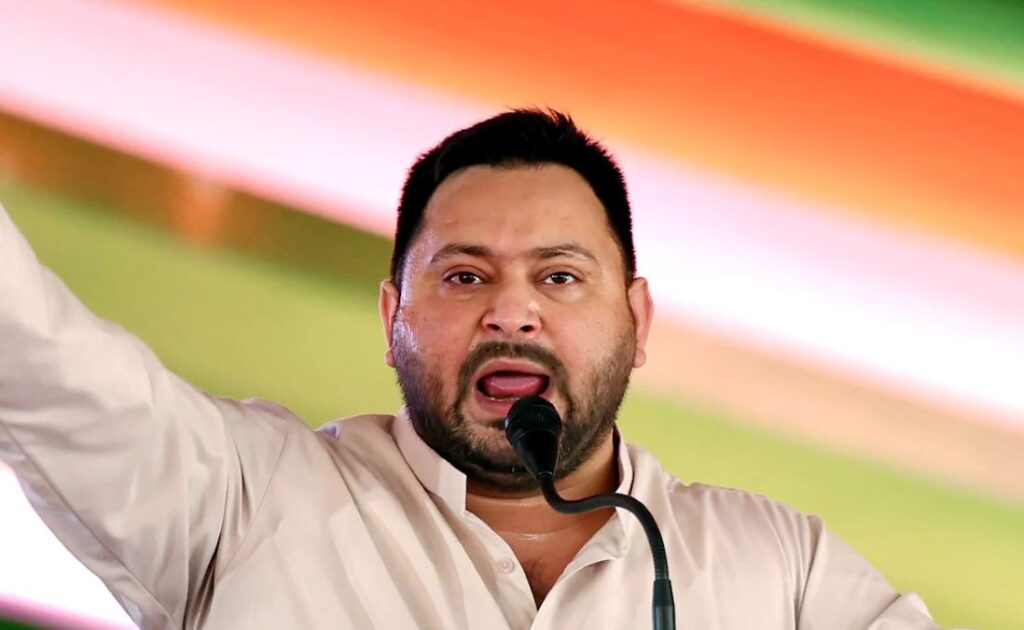
In what can only be described as a political earthquake, the National Democratic Alliance (NDA) has delivered a crushing blow to the Rashtriya Janata Dal (RJD)-led Mahagathbandhan, surging past the 200-seat mark in Bihar’s 243-member assembly. As counting concluded late on Friday, the NDA secured a landslide victory – its most dominant performance since the historic 206-seat sweep in 2010 – effectively burying Tejashwi Yadav’s ambitious bid to become India’s youngest chief minister at age 36.
The verdict is stark: voters have overwhelmingly rejected the opposition’s narrative of “change” and “jungle raj redux,” instead reaffirming faith in Chief Minister Nitish Kumar’s “sushasan” (good governance) and Prime Minister Narendra Modi’s development guarantees. With the BJP emerging as the single-largest party (around 90-100 seats) and JD(U) close behind, the alliance’s unity proved unbreakable, while the Mahagathbandhan crumbled to under 40 seats, its lowest tally in over a decade.
A Campaign Built on Hope, Crushed by Reality
Tejashwi Yadav entered the fray with youthful energy and a carefully crafted image as the harbinger of a “new Bihar.” The RJD scion, who had positioned himself as deputy CM in the 2020-22 grand alliance government, promised 10 lakh jobs, an end to migration woes, and a sharp critique of Nitish Kumar’s frequent alliance flips – earning him the moniker “Paltu Ram” from opponents. His rallies drew massive crowds, especially among the youth and the Yadav-Muslim (MY) base that has long been RJD’s backbone.
The Mahagathbandhan’s strategy hinged on anti-incumbency after two decades of Nitish rule, amplified by Congress’s aggressive “vote chori” allegations over the Election Commission’s Special Intensive Revision (SIR) of voter rolls. Rahul Gandhi’s padyatras and attacks on electoral reforms were meant to fire up the base, while allies like CPI(ML) targeted rural discontent.
Yet, as results poured in, the dream evaporated. The RJD, which had emerged as the single-largest party with 75 seats in 2020, was reduced to a distant second, clinging to around 25-35 seats – many in its traditional Yadav strongholds. Congress, the alliance’s supposed booster, performed disastrously, scraping together single-digit wins despite contesting over 60 seats. The Left parties salvaged a handful, but the coalition’s vote share dipped below 37%, fragmented further by third-front players like Prashant Kishor’s Jan Suraaj (which drew blanks) and a resurgent AIMIM in Seemanchal pockets.
Why the NDA Tsunami?
Several factors converged to create this perfect storm for the ruling alliance:
- Women’s Wave: Bihar’s female voters, turnout at a record 71.6% (higher than men’s 62.8%), tilted decisively toward the NDA. Schemes like free electricity, piped water, and women’s reservation resonated deeply. PM Modi’s reframing of the old “MY” (Muslim-Yadav) equation to a new one – Mahila (women) and Yuva (youth) – struck a chord, countering caste-based appeals.
- Nitish’s Resilience: Despite flip-flop jibes, the 74-year-old JD(U) supremo projected stability and development. His focus on law and order, infrastructure (roads, bridges, ethanol plants), and welfare for Extremely Backward Classes (EBCs) consolidated non-Yadav OBCs and Mahadalits.
- Modi’s Magic: The Prime Minister’s high-octane campaign – over a dozen rallies – invoked “jungle raj” fears from the Lalu era, positioning the NDA as the guardian against anarchy. His guarantees on jobs, security, and national pride mobilized first-time and floating voters.
- Alliance Arithmetic: Chirag Paswan’s LJP(Ram Vilas) delivered a near-perfect strike rate (20+ seats), consolidating Dalit votes. Smaller partners like HAM and RLM added marginal gains, while the BJP’s organizational muscle overshadowed JD(U) in many regions.
- Opposition Missteps: Tejashwi’s aggressive promises failed to convert into votes amid perceptions of dynasty politics. The “vote chori” narrative backfired as a sign of desperation, and internal rifts – including celebrity candidates underperforming – hurt credibility.
Personal Triumphs and Heartbreaks
Tejashwi Yadav salvaged personal pride by retaining Raghopur with a margin of over 14,000 votes – a hat-trick in the family bastion – but the joy was bittersweet. His brother Tej Pratap trailed badly in Mahua, symbolizing the Yadav clan’s diminishing clout beyond pockets.
On the NDA side, celebrations erupted: Deputy CMs Samrat Choudhary and Vijay Sinha won comfortably, jailed strongman Anant Singh returned triumphantly for JD(U), and folk singer Maithili Thakur scripted history for BJP. Chirag Paswan emerged as the big gainer, proving his 2024 Lok Sabha success was no fluke.
Prashant Kishor’s much-hyped Jan Suraaj debut fizzled out with zero seats, validating his own pre-poll prediction of either “under 10 or over 150.”
What Next for Bihar – and Tejashwi?
Nitish Kumar is set for a record 10th oath-taking, likely cementing his legacy as Bihar’s longest-serving CM. The BJP’s surge as the largest party could spark internal dynamics over power-sharing, but for now, unity prevails.
For Tejashwi, this is a brutal setback. At 36, he remains the opposition’s face, but the RJD must introspect: Has over-reliance on MY votes hit a ceiling? Can it broaden appeal beyond caste? The road to 2030 starts with rebuilding a shattered cadre and addressing why promises of “nyay” (justice) rang hollow against “vikas” (development).
Bihar has spoken loudly: Stability over upheaval, governance over grievances. In a state long synonymous with chaos, this mandate is a resounding endorsement of progress – and a harsh lesson for those who underestimated the voter’s maturity.
As fireworks lit up Patna’s skies and NDA workers danced to “Phir Ek Baar, Modi Sarkar,” one thing is clear: Tejashwi’s dream of the CM’s chair will have to wait. Perhaps much longer than he imagined.
Last Updated on: Friday, November 14, 2025 9:21 pm by Tamatam charan sai Reddy | Published by: Tamatam charan sai Reddy on November 14, 2025 9:21 pm | News Categories: News
About The Author
